

Upgrading Guide for Flooring Aesthetics with Designer Floor Registers
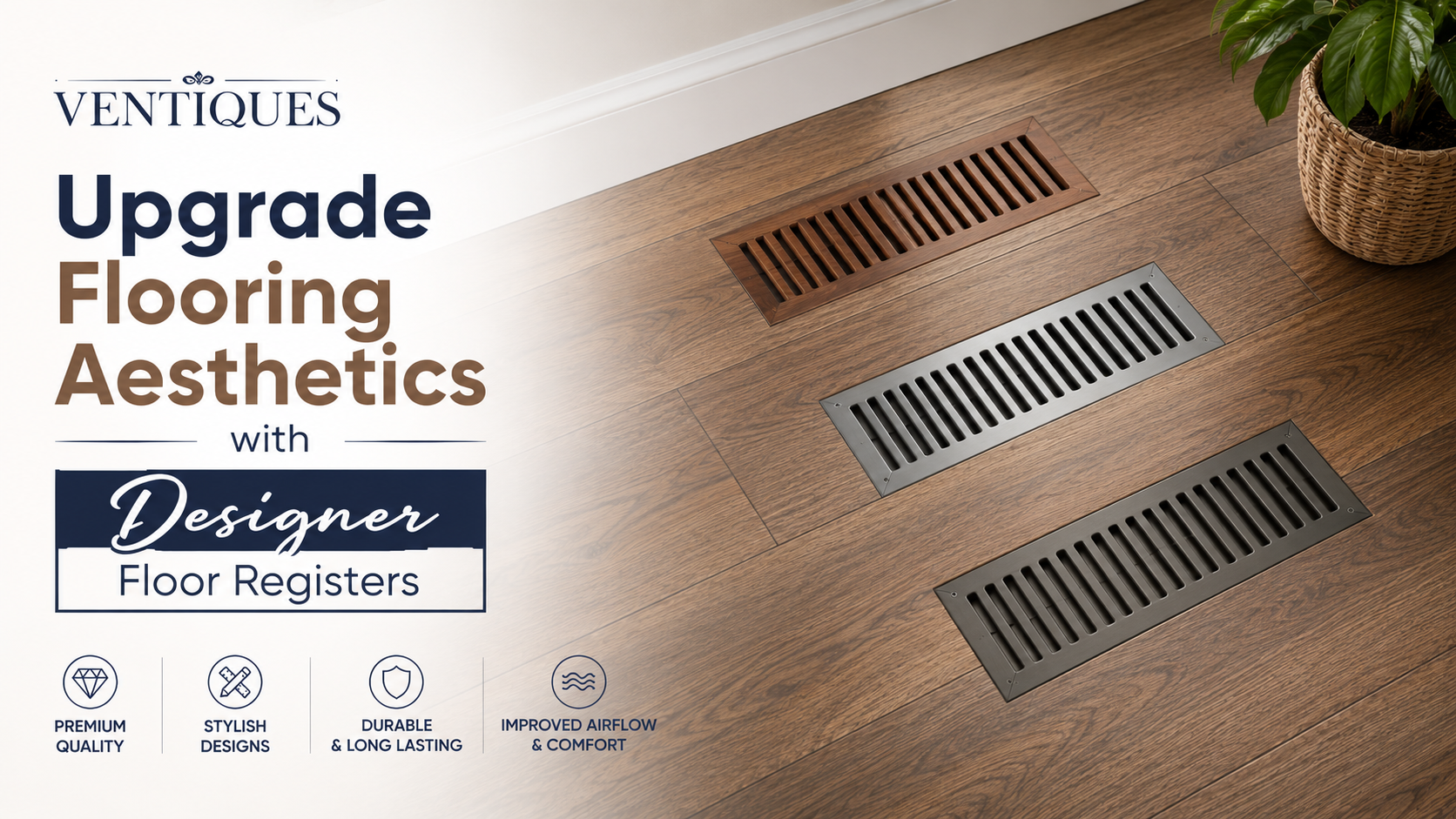
Designer Floor Registers
Upgrading Guide for Flooring Aesthetics with Designer Floor Registers
MINNESOTA, MN, UNITED STATES, June 3, 2026 /EINPresswire.com/ -- Upgrading Guide for Flooring Aesthetics with Designer Floor RegistersFlooring gets a lot of attention in interior design conversations — and rightly so. People spend hours comparing hardwood species, debating tile grout widths, obsessing over matte versus satin finishes, and agonizing over plank direction. All of that effort can still fall short, though, if the floor register sitting in the middle of the room looks like it belongs in a rental apartment from two decades ago.
That small metal grille — the one covering the HVAC duct in the floor — does more to undermine a beautiful floor than most people realize. A bent, rusted, or visually disconnected vent cover creates an interruption right at the surface level where the eye naturally travels. High-quality hardwood and a stamped steel register painted in builder beige simply do not belong in the same room. Yet that combination shows up constantly in homes where significant money was spent on flooring and almost none was spent on the component that sits inside it.
Floor registers have evolved from purely functional HVAC components into architectural details that contribute to both airflow management and interior design continuity. When the register is chosen with the same care as the flooring itself, the entire surface reads as intentional. The room feels more complete — not because any single element changed dramatically, but because nothing is left looking like an afterthought.
Why the Floor Register Is a Bigger Deal Than It Looks
The floor is the visual foundation of a room. Furniture sits on it, light falls across it, and the eye reads it first when entering a space. Any interruption in that surface — no matter how small — registers (no pun intended) on a subconscious level.
Standard or builder-grade vents tend to stand out for all the wrong reasons. Thin stamped metal flexes underfoot. Paint chips along the louver edges after a few years of vacuuming. Rust stains creep into grout lines on tile floors. And the sizing is rarely exact, leaving small gaps around the frame that collect dust and look perpetually unfinished.
A designer register addresses all of that. The frame sits flush and tight. The material holds up over time. The finish was chosen to coordinate with the floor around it rather than simply avoid clashing with it. That difference — between a register that merely does not fit the floor and one that actually belongs on it — changes how the whole room looks.
Floor registers are crucial and an active component in the HVAC system. Air moves through them constantly. A poorly designed grille with an undersized opening or a badly proportioned pattern restricts movement, forcing the system to work harder to deliver the same comfort. A well-constructed register supports airflow instead of fighting it. Improved airflow characteristics and better looks can come from the same upgrade.
Designer Air Vents: Where Function Finally Meets Good Design
For a long time, air vents were treated as something to ignore. Cover the duct, move on, and hope nobody looks too closely. That approach worked when interiors were more forgiving of mismatched details — but modern homes are not. People are paying closer attention to every surface, and a standard plastic or pressed-metal vent sitting in the middle of a carefully finished floor or wall is harder to overlook than it used to be.
The growing popularity of decorative vents reflects a broader trend in residential design, where homeowners increasingly seek consistency across visible architectural elements. Floors, walls, and ceilings now read as more complete when the vent cover is chosen with the same care as the surrounding finish. That shift did not happen overnight, but it has become real, and it has made decorative vents one of the more practical and design consideration available in interior renovation.
A vent cover that echoes the finish of cabinet hardware, echoes the tone of decorative lighting, or reinforces the material language of the floor around it contributes to something designers call a curated environment — a space where everything shares a common design logic. Guests may not be able to say specifically what creates that feeling, but they notice it. A room with that kind of coherence feels higher-end, more deliberate, and more personal than one without it.
Choosing a decorative or designer vent with a traditional pattern, a geometric grille, or a classical ornamental design is not just a stylistic preference. It is a commitment to a longer view — one that values elements that remain attractive over time rather than following a trend that will feel dated in a few years.
Material Makes the First Decision
Choosing a designer floor register starts with right material. Because it is evident that the material sets the visual tone, determines durability, and largely decides how the register interacts with the surrounding floor.
Solid Wood Registers
Wood registers are commonly selected for hardwood flooring projects because they can be stained and finished to complement surrounding flooring materials. They are manufactured from species like oak, maple, cherry, walnut, etc.
One practical note: solid wood registers work better in dry climates or climate-controlled homes. Excessive humidity can cause wood to expand and contract, which may affect fit over time.
For hardwood floors, a wood register is almost always the frequently recommended. Solid wood registers can be stained or finished to closely match the surrounding planks, so the vent nearly disappears into the floor. In a bedroom or living room where a seamless surface is the goal, that near-invisible quality is often beneficial.
Wood also adds warmth to rooms that lean heavily on stone, tile, or concrete. Those materials can read as cool and somewhat impersonal. A wood register reintroduces a natural element that softens the overall atmosphere without requiring any other change.
Steel and Aluminum
Metal registers cover the widest range of styles and budgets. Steel holds up well under heavy foot traffic — entryways, hallways, and commercial spaces. It is well-regarded for its durability. Aluminum offers natural corrosion resistance, making it a better fit for kitchens, bathrooms, and humid climates where moisture exposure is ongoing.
Both metals accept a wide range of finishes. Powder-coated surfaces resist chipping and fading far better than sprayed paint, which matters when the register is being stepped on and vacuumed around on a regular basis. Laser-cut metal patterns enable precise, modern grille designs that would not be possible with traditional stamping.
Brushed Stainless Steel
For very modern or minimalist spaces, brushed stainless steel offers a neutral, architectural quality. Unlike chrome, brushed stainless steel does not draw attention to itself. It sits quietly in the floor, doing its job without visual drama — which, in a spare, carefully edited interior, is exactly the right choice.
Cast Iron
Cast iron registers are a nod to history. Many older homes originally featured ornate cast iron grilles with intricate floral, geometric, or Victorian scroll patterns.
But cast iron is not only for restoration work. Contemporary cast iron registers with clean geometric patterns can anchor a room with an industrial or loft aesthetic effectively. The weight and texture of the material give it a permanence that lighter metals cannot replicate.
Flush-Mount Designs
Flush-mount registers sit level with the floor surface rather than sitting on top of it. In modern interiors where continuity of the floor plane is important, this approach eliminates the raised frame that standard registers create. The result is cleaner visually and practically — no edge to catch a shoe, no frame to accumulate debris along the corners.
Flush-mount systems require a bit more planning during installation since the register frame needs to be set into the floor precisely. When done well, the payoff is significant.
Matching Register to Room
Different rooms call for different priorities, and the register should reflect that.
Bedrooms benefit from quiet visual integration. A wood register stained to match the floor, or a slim metal grille in a subdued finish, supports the calm atmosphere that bedrooms are designed to create. Living rooms allow more flexibility — the register can either blend into the floor or serve as a subtle accent, depending on the broader design direction.
Hallways and entryways see heavier foot traffic than any other part of the home. Material durability becomes more important in those spaces. Steel or cast iron registers hold up better than wood under that kind of daily use.
Kitchens and bathrooms have moisture. Wood registers are generally not preferred in those environments. Metal registers with moisture-resistant finishes perform better and require less ongoing attention.
Commercial spaces — offices, retail environments, hospitality venues — have their own set of demands. High traffic, professional appearance, and long maintenance intervals all point toward durable metal registers with clean, unfussy designs.
Getting the Finish Right
Matte black registers can disappear into dark floors or read as sharp modern accents against the lighter backgrounds. Brushed nickel holds a contemporary, neutral quality suitable for kitchens and bathrooms. Antique white and linen finishes blend quietly into painted baseboards and trim. Wood finishes, can be easily matched to flooring almost grain for grain.
Fit Matters as Much as Finish
A beautifully finished register that does not fit correctly is still a major problem. Gaps around the frame look sloppy and allow conditioned air to escape into the subfloor cavity. A loose grille rattles when air moves through it.
Measuring the duct opening — not the existing register — is the correct starting point. Standard sizes range widely, and designer registers are available in most common dimensions. For non-standard openings, some manufacturers offer custom sizing.
Long-Term Value of the Investment
Designer floor registers typically carry a higher upfront cost than standard builder-grade options, reflecting differences in materials, finishes, and manufacturing methods. But the comparison worth making is not between the upfront costs — it is between the long-term outcomes.
There is also the value of the appearance itself. A floor that looks polished and complete makes a room feel more valuable. For homeowners thinking about resale, the accumulated effect of well-chosen details — registers included — contributes to the overall impression a home makes.
Grille Patterns and What They Communicate
Beyond the material, the grille's pattern carries design weight. The most common patterns fall into a few broad categories.
Bar and Louver Patterns are the most traditional. Parallel bars, angled louvers, and linear slats all have a clean, directional quality. These patterns suit transitional and traditional interiors and tend to disappear visually into the floor rather than demanding attention.
Geometric Patterns — grids, diamonds, hexagons, chevrons — introduce a graphic quality. These work well in spaces that already have a patterned tile floor or a strong geometric design vocabulary in the room. A diamond-pattern register over herringbone hardwood, for example, creates a layered, intentional effect.
Scrollwork and Ornate Patterns belong in formal or period spaces. Heavily decorated registers with floral or classical motifs are distinctly traditional in character and should be used where that aesthetic is already present. Used in the wrong context, they read as overly decorative.
Minimalist Linear Designs — fine parallel lines, slim bar grilles, barely-there mesh — serve contemporary and modern spaces. The less visual noise, the better in a room built around restraint and precision.
Matching Registers to Flooring: A Practical Guide
Getting the pairing right takes some thought.
Here are a few principles that hold across most situations.
Match material to material when possible. Wood floors pair best with wood registers. Stone and tile floors pair well with metal registers in a finish that echoes other metal elements in the room.
Match finish to existing hardware. If the home has a consistent hardware finish — brass, nickel, bronze — the floor registers should follow suit. Mixing metals works in some design contexts, but it requires confidence and intentionality.
Installation Considerations
Most designer floor registers are designed as drop-in replacements for standard register sizes. Before purchasing, measure the opening in the floor — the duct opening, not the existing register — and confirm the size. Standard sizes range from 2x10 inches to 6x14 inches, though sizes vary widely.
Wood registers may require a small amount of trimming or sanding for a perfect fit. Metal registers typically drop in without modification.
Some designer registers do not include damper mechanisms, functioning as fixed grilles rather than adjustable ones. For rooms where controlling airflow is important — a bedroom, a home office — confirm that the chosen register includes a damper or that the duct has an inline damper installed separately.
Beyond Functionality: Registers as Decor
Custom and artisan register makers offer options that go well beyond what is available at a home improvement store. Hand-forged iron registers with unique patterns, registers inlaid with tile to match surrounding flooring, registers with laser-cut geometric precision — these exist, and they are not as expensive as one might expect.
Some flooring contractors and tile installers now offer tile-inset registers as part of a flooring package. The register frame is installed flush with the subfloor, and matching tile is cut and set within the frame. The result is a grille that looks like part of the floor itself, with only a thin frame revealing the air gap below.
Conclusion: The Small Detail That Completes the Room
Interior design rewards those who pay attention to what most people ignore. Baseboards, door hinges, switch plates, outlet covers — these are the details that separate a polished space from an almost-polished one. Floor registers belong on that list.
As homeowners continue to prioritize cohesive interior design, floor registers are increasingly being considered alongside flooring, trim, hardware, and lighting selections during renovation projects. The floor reads as finished. The room reads as considered. The whole space feels like it was thought through.
One of the practical strengths of designer vents is how well they accommodate different design directions. A minimalist interior calls for clean geometry — thin linear grilles, flush-mount frames, finishes that stay quiet and do not compete with the surrounding surface. A traditional home might call for something more ornamental — a scrollwork pattern, an antique bronze finish, a design that echoes woodwork and molding details found elsewhere in the room.
Nick
Ventiques
+1 320-292-7582
email us here
Visit us on social media:
LinkedIn
Instagram
Facebook
YouTube
Innovation Meets Style. Check out the all-new adjustable height flush mount floor vent by Ventiques
Legal Disclaimer:
EIN Presswire provides this news content "as is" without warranty of any kind. We do not accept any responsibility or liability for the accuracy, content, images, videos, licenses, completeness, legality, or reliability of the information contained in this article. If you have any complaints or copyright issues related to this article, kindly contact the author above.
